The Definitive Guide to Cyber Catastrophe Modeling for Insurers, Reinsurers and ILS Investors.
A comprehensive walkthrough of event-based cyber cat modeling — from technology dependency mapping and event generation to loss estimation and portfolio stress-testing.
Introduction
Cyber catastrophe modeling is the process of estimating the financial impact of large-scale, correlated cyber events that affect many organizations simultaneously. Unlike traditional single-risk assessment, cyber catastrophe modeling focuses on systemic exposure, portfolio accumulation, and tail-risk scenarios that can threaten the stability of entire insurance markets.
As cyber risk continues to evolve through increasing cloud dependencies, shared infrastructure, and interconnected supply chains, insurers face an urgent need for models that go beyond static assumptions. Cyberwrite delivers a next-generation cyber catastrophe modeling platform that enables insurers, reinsurers, and ILS investors to quantify systemic cyber risk using live, real-world company data and transparent event-based modeling.
What is Cyber Catastrophe Modeling?
Cyber catastrophe modeling enables insurance organizations to understand how a single cyber event can trigger widespread losses across thousands of insured entities at the same time. These events may originate from failures or attacks on critical digital infrastructure such as cloud service providers, software platforms, operating systems, or managed service providers.
The purpose of cyber catastrophe modeling is to calculate potential portfolio loss, measure accumulation risk, and support informed decisions around pricing, capacity allocation, capital adequacy, and regulatory compliance. A robust model should provide insight into peak losses, probability distributions, and portfolio vulnerabilities under realistic systemic cyber scenarios.
Why Traditional Cyber Models Fall Short
Many existing cyber models still rely heavily on predefined scenarios and synthetic assumptions that lack transparency into how losses accumulate across real portfolios. These models struggle to reflect true digital dependencies and often fail to explain why specific losses occur.
This lack of clarity creates challenges for underwriters, exposure managers, and boards who must justify capital decisions under regulatory scrutiny. It also increases model risk and limits confidence in the outputs. Traditional approaches frequently overlook granular entity-level exposure, resulting in incomplete risk representation across SMBs and large enterprises alike.
Rather than relying purely on static scenarios, Cyberwrite models event footprints based on observed real-world conditions — dependencies on cloud services, critical software providers, and supply chain technology relationships.
How Cyberwrite Redefines Cyber Catastrophe Modeling
Cyberwrite introduces a fundamentally different approach to cyber catastrophe modeling by using:
- Real company data across hundreds of millions of global entities
- Event-based modeling driven by actual digital dependency mapping
- Transparent loss formation logic that explains why accumulation occurs
- Dynamic simulation of correlated multi-entity cyber events
- Tail-risk analysis with detailed exceedance probability curves
The result is a modeling solution that delivers higher transparency, lower model risk, and greater decision confidence for cyber insurance stakeholders.
Real-World Use Cases
Cyber catastrophe modeling serves as a critical tool for:
- Evaluating aggregate exposure across cyber insurance portfolios
- Understanding accumulation risk at sector, geography, and technology level
- Supporting reinsurance purchasing decisions
- Informing capital allocation strategies
- Stress testing portfolios for systemic cyber events
- Demonstrating model transparency to regulators and rating agencies
Technology Dependency Mapping: The Foundation of Event-Based Modeling
The core innovation in Cyberwrite's approach is mapping the technology dependencies of each insured entity in real time. Rather than asking insureds what software they use (which produces unreliable, outdated answers), Cyberwrite scans internet-facing infrastructure to detect which cloud providers, SaaS platforms, CDN providers, DNS services, and managed service providers each company relies on.
This creates a live dependency graph for each insured — and when aggregated across a portfolio, reveals which technology nodes are shared by the largest number of insureds. These high-connectivity nodes represent the greatest systemic risk concentration and are the starting points for event-based scenario generation.
Event Generation and Loss Estimation
Cyberwrite's model simulates events starting from a disrupted technology node and propagating outward to all entities that depend on it. For each affected entity, the model calculates expected loss based on company size, industry, coverage type, inherent risk score, and residual risk signals — producing a company-level loss estimate that aggregates to a realistic portfolio loss.
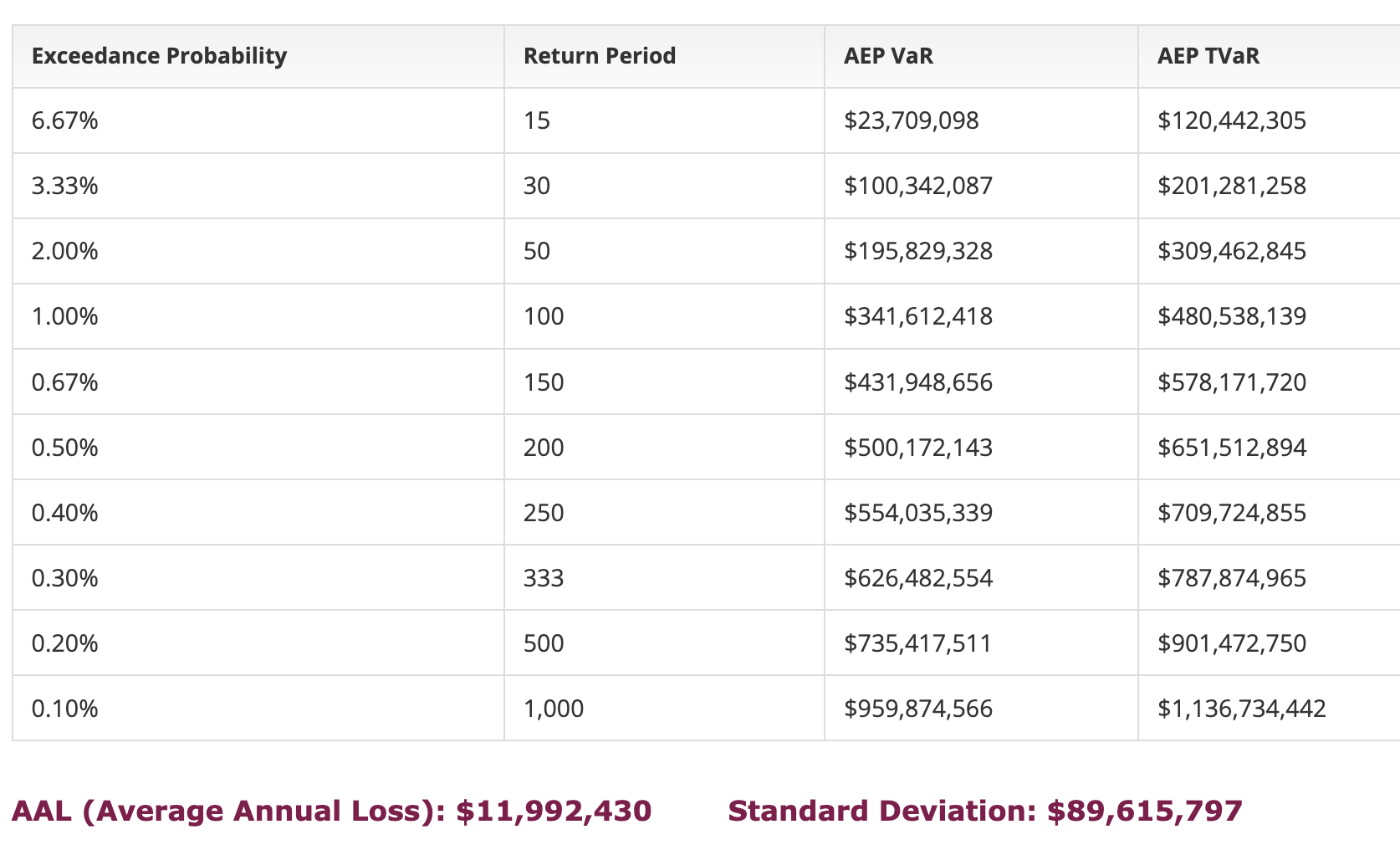
By simulating thousands of events across hundreds of potential technology failure points, Cyberwrite's model generates exceedance probability curves that show the probability distribution of portfolio losses at different return periods — from 1-in-10 to 1-in-250 year events. These outputs are the inputs reinsurers, ILS investors, and capital providers need to make informed decisions.
Exceedance Probability Curves and OEP/AEP
Occurrence Exceedance Probability (OEP) and Aggregate Exceedance Probability (AEP) curves are the standard outputs of catastrophe models. OEP shows the probability that the largest single event in a given year exceeds a certain loss level. AEP shows the probability that the total of all events in a year exceeds a threshold.
For cyber risk, AEP is particularly important because the line between attritional and catastrophic loss is not always clear — a series of moderately large events in a single year can create as much financial pressure as a single major catastrophe. Cyberwrite's model produces both OEP and AEP outputs, giving portfolio managers a complete picture of tail risk.
Transparency as a Competitive Requirement
As regulators, reinsurers, and rating agencies increase scrutiny of cyber risk models, transparency has become a competitive requirement — not just a nice-to-have. Cyberwrite's model is designed to explain every loss estimate: which dependency triggered the event, which entities were affected, and which risk factors drove the loss calculation for each affected insured.
This explainability supports model validation by internal risk teams, reinsurance broker due diligence, regulatory stress testing, and board-level risk governance. It also builds confidence among capacity providers who need to understand what they are covering before they commit capital.