The Annual Cyber Rendezvous at Lloyd's: Close to 80 Cyber Insurance Leaders on Underwriting, Catastrophe Modeling and AI
Cyberwrite and Samsung Re brought the London market together at the Lloyd's Old Library for a half-day executive briefing. Four sessions, two expert talks and a networking lunch, under the Chatham House Rule.
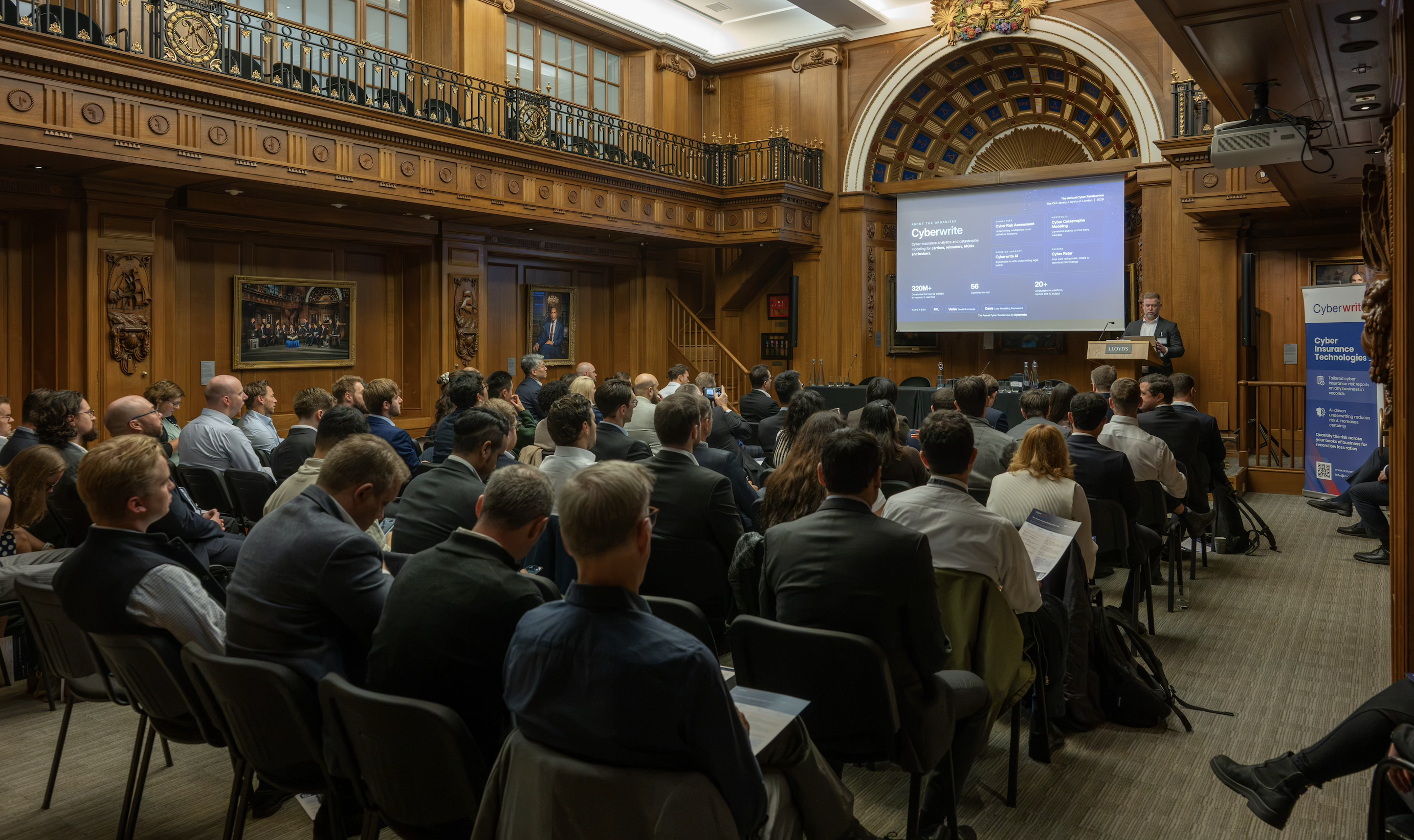
In October 2026 Cyberwrite hosted the Annual Cyber Rendezvous at the Lloyd's Old Library, One Lime Street, with Samsung Re as host. Close to 80 senior professionals from carriers, reinsurers, Lloyd's syndicates, MGAs and brokers attended, against 89 registrations. Attendance was limited to insurance and reinsurance professionals, and every registration was reviewed, so the room was made up of the people who underwrite, model, broke and pay cyber claims. The event is independently organised by Cyberwrite and is not an official Lloyd's event.
The discussions ran under the Chatham House Rule, so this recap covers the programme and the themes, not who said what.
The programme
Opening remarks. Nir Perry, CEO and Founder of Cyberwrite, and Sie Lau, Head of Cyber and Casualty at Samsung Re, opened with the state of the cyber insurance market and the role of data-driven underwriting and portfolio-level catastrophe modeling.
Fireside chat: the threat picture, now and the next 24 to 48 months. John Evans, Head of the Cyber Policy Unit at the UK Home Office, in conversation with Nir Perry. The first half covered the current threat environment from a government perspective; the second half looked at what changes over the next two to four years, followed by audience questions.
Panel: Cyber Underwriting, Data, Discipline and Decision Support. Moderated by Nir Perry, with Marco Henrique (Head of Cyber Europe, Markel Insurance SE), Jean Bayon de La Tour (International Head of Cyber, Howden), Phil Hoyt and Siobhan O'Brien. The panel covered external data in risk selection, triage and pricing; the signals that correlate with claims; validating controls without slowing quote-to-bind; and moving from questionnaires to evidence-based assessment.
Panel: Cyber Catastrophe Modeling and Systemic Risk. Moderated by Sie Lau, with Lauren Restell (Exposure Management, Non-Natural Catastrophe, Lloyd's), Sarah Payne (Cyber Cat Modeling Manager, Aon) and Simon Heather (Head of Cyber Catastrophe Modeling, Gallagher Re). The panel covered accumulation and concentration management, cloud and software supply-chain exposure, single points of failure, capital setting and reinsurance purchasing, and Lloyd's Realistic Disaster Scenario requirements.
Talk: Oasis and open catastrophe modeling for cyber. Dickie Whitaker, Chief Executive of the Oasis Loss Modelling Framework, on the Oasis platform and the Oasis Cyber partnership with Cyberwrite.
Talk: Five lessons from cyber claims, and where AI fits. Luke Johnson, Cyber Claims Advocate and Solicitor at Lockton, on what claims experience teaches about policy wording, response and recovery.
Panel: AI on Both Sides of the Ledger. Moderated by Nir Perry, with John Evans (UK Home Office) on malicious use of AI, Sophia Kalanovska (Red Berry) on non-malicious and agentic AI risk, Michael Georgiou (Head of Portfolio Risk, CFC) on AI in portfolio analytics, and Craig Dunn (Senior Cyber Underwriter, Samsung Fire & Marine Insurance) on the underwriting landscape ahead.
Networking lunch in the Old Library.
Themes that ran through the day
- The gap between what a cyber policy pays and what an incident costs is the central underwriting problem. Limits, severity curves and accumulation need to be anchored to ground-up economic loss, not only to claim benchmarks. Cyberwrite's new study on this, published this month, was presented in the opening session.
- Systemic events through shared vendors, platforms and service providers are where claim data most consistently understates loss, and where portfolio-level cyber catastrophe modeling earns its place next to single-risk assessment.
- External, evidence-based data is replacing questionnaires in risk selection and triage, provided it does not slow the quote-to-bind process.
- AI is a two-sided risk: it accelerates attacks and introduces new non-malicious and agentic failure modes, while also changing how portfolios are analysed and underwritten. Governance, explainability and human oversight were recurring conditions.
- Claims experience is the best test of wording and process; the lessons from recent claims point to specific changes in how cover is structured and how response is managed.
Thank you
Our thanks to Samsung Re for hosting, to Lloyd's for the Old Library, to every speaker and panellist, and to the attendees who made the conversations worth having. Registration for the next Annual Cyber Rendezvous will open in 2027; attendance will again be limited to insurance and reinsurance professionals.